
Why your brain won’t cooperate at work (and what actually helps)
You’re sitting there.Screen open.Work in front of you. And your brain just… doesn’t engage. You reread the same sentence.Forget what you were…
You’re sitting there.
Screen open.
Work in front of you.
And your brain just… doesn’t engage.
You reread the same sentence.
Forget what you were doing mid-task.
Switch tabs without meaning to.
It’s not that you don’t want to focus.
It’s that you can’t focus at work right now.
This is what “brain fog at work” actually feels like
It’s not always dramatic.
Sometimes it’s:
- staring at your screen but not processing anything
- simple tasks feeling weirdly heavy
- forgetting things you just thought about
- needing way more effort for basic decisions
That slow, blurry feeling?
That’s brain fog at work.
And it’s often paired with something deeper:
mental fatigue from work that hasn’t been resolved.
Why your brain won’t cooperate (even if you “should” be able to)
This is the part most advice gets wrong.
It tells you to:
- try harder
- be more disciplined
- eliminate distractions
But your brain isn’t refusing.
It’s protecting you.
When your nervous system is overloaded, your brain shifts out of “focus mode” and into survival mode.
That can look like:
- fight → irritability, frustration
- flight → restlessness, task switching
- freeze → blank mind, shutdown
- fawn → people-pleasing instead of prioritizing
Focus requires safety + available energy.
If your system doesn’t have those…
You get fog.
You get resistance.
You get that “why can’t I just do this?” feeling.
The real reason you can’t focus at work
It’s not laziness.
It’s overload.
Too many inputs.
Too many decisions.
Too little recovery.
Your brain starts conserving energy by:
- reducing clarity
- slowing processing
- avoiding effort-heavy tasks
Which is why pushing harder usually makes it worse.
What actually helps (when your brain won’t engage)
Not a full routine overhaul.
Not a productivity system.
You need something your nervous system can accept.
Start smaller.
Try this instead of pushing through:
A 5-minute reset
That’s it.
Not an hour.
Not a full break.
Just enough to interrupt the overload loop.
Simple options:
- step away from the screen and look at something distant
- drink water slowly (no multitasking)
- take 10 slow breaths with longer exhales
- unclench your jaw + drop your shoulders
- sit still and do nothing for 2 minutes (yes, really)
This isn’t about “optimizing.”
It’s about signaling to your brain:
you’re not under threat right now
That’s what brings your focus back online.

If this keeps happening, it’s not random
If you regularly:
- can’t focus at work
- feel constant brain fog
- hit a wall halfway through the day
Your system isn’t getting the reset it needs.
You don’t need more pressure.
You need repeatable, low-effort ways to come back online.
What to do next
If this article resonated, two doors from here — pick whichever fits where you are:
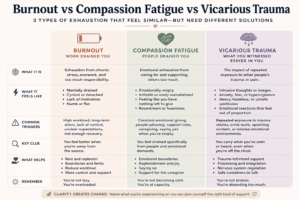
Door 1 — Find out which kind of exhaustion is actually yours. The free Burnout Profile is a 5-minute assessment that gives you a clear read on your severity and your pattern — so you stop using the wrong recovery on the wrong kind of depletion. You’ll get your detailed profile in your inbox, plus a few honest, non-spammy notes on what tends to help.
Take the free Burnout Profile →
Door 2 — Come and have the conversation with us. The Burnout Survival Club is a small (and currently free) community where we work through this stuff one honest conversation at a time. No fixing, no toxic positivity, no “have you tried yoga.” Just real recovery, with people who get it.
Join the Burnout Survival Club →
Final note
If your brain won’t cooperate…
It’s not because you’re failing.
It’s because your system is asking for a different approach.
Less force.
More regulation.
That’s where focus starts to come back.