You’re Not “Just Burnt Out”: The Three Kinds of Exhaustion Most People Keep Confusing
You keep calling it burnout. But rest isn’t fixing it. You take leave. You sleep more. You try to “reset.” And somehow…
You keep calling it burnout.
But rest isn’t fixing it.
You take leave. You sleep more. You try to “reset.” And somehow you still wake up feeling like a hollowed-out version of yourself.
That’s usually the clue.
It’s not that you’re failing at recovery. It’s that “burnout” has become a catch-all word — and underneath it sit three very different things, each with their own root cause and their own kind of repair.
Here’s the part nobody tells you: not all exhaustion is the same. And if you treat all of it like burnout, you’ll keep using the wrong kind of recovery on the wrong kind of depletion.
The three things people lump together
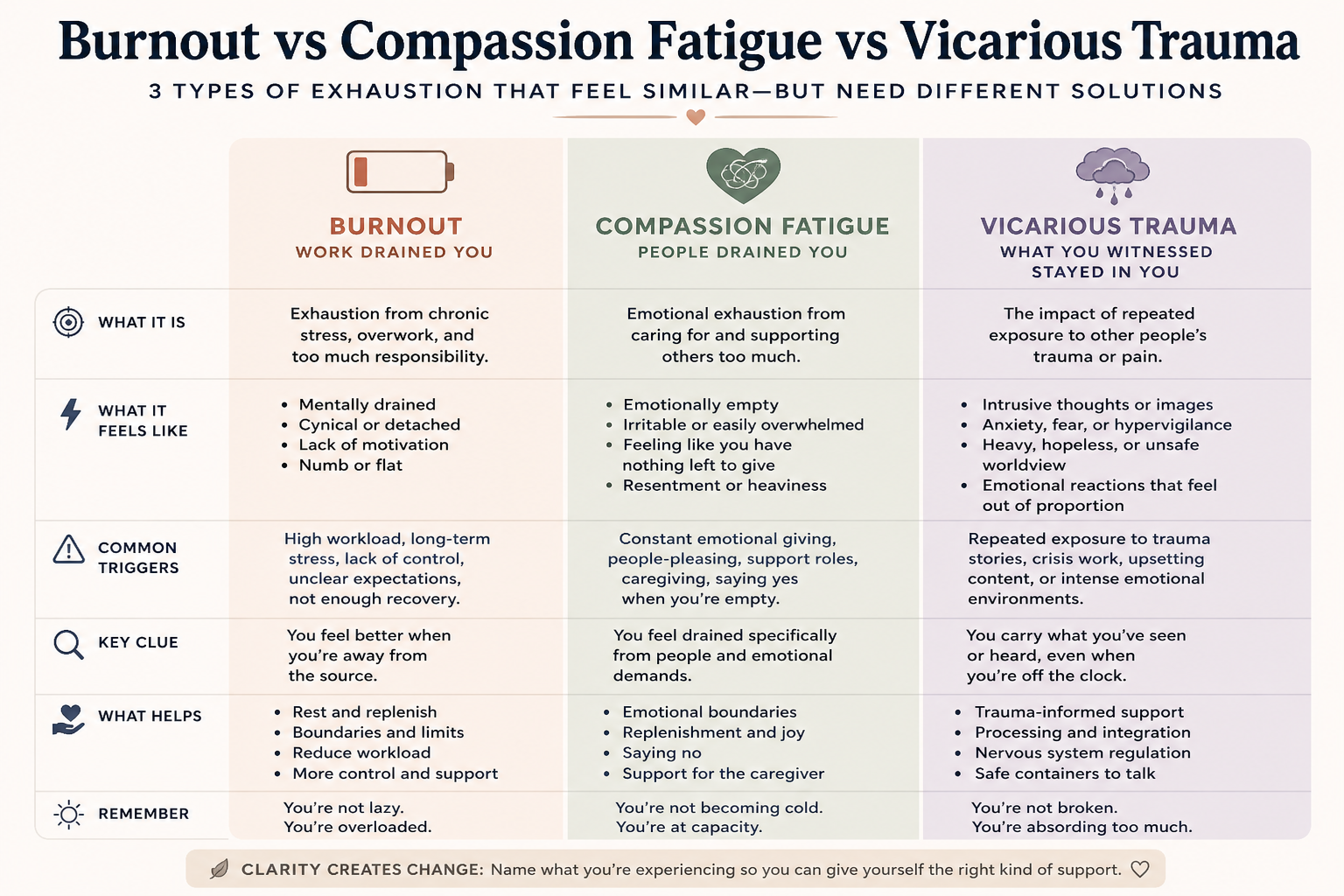
In the research, and in the therapy room, three patterns keep getting confused with each other:
- Burnout — work drained you
- Compassion fatigue — people drained you
- Vicarious trauma — what you witnessed stayed in you
Same surface feeling: “I’m exhausted.” Different root causes. And the difference matters more than most people realise — because it changes what actually helps.
Burnout: when the system overloads
Burnout is the one most people default to. And sometimes they’re right.
It usually feels like:
- mental fog
- low motivation
- cynicism or detachment
- “I just don’t care anymore” energy
- everything feeling harder than it should
It comes from chronic stress — usually tied to work, caregiving, or sustained responsibility. Too much demand. Not enough recovery. For too long. Your nervous system has been running on the back-up generator, and now the back-up generator is also tired.
Here’s the key pattern: burnout improves with distance.
When you step away — take leave, reduce workload, create space — you start to feel better. Slowly. Sometimes incompletely. But there’s movement.
If rest helps, even a little, you’re likely dealing with burnout.
If you want a more thorough read than three quick questions can give you, take the free Burnout Profile — a 5-minute interactive assessment that tells you your severity (where you are right now) and your pattern (which of these three it actually is). It’s the same diagnostic from the Burnout Reset Kit, made interactive.
Take the free Burnout Profile →
Compassion fatigue: when caring becomes heavy
This is the one a lot of high-functioning, empathetic people miss.
Especially if you’re a therapist, nurse, doctor, social worker, teacher, coach, caregiver — or just “the reliable one” everyone leans on.
Compassion fatigue feels like:
- emotional exhaustion that lives underneath the work tiredness
- irritability or numbness toward the people you usually care about
- feeling like you have nothing left to give
- quiet resentment where there used to be care
- guilt for feeling any of the above
That last bit can feel confronting. Because you do care. Of course you do. But your emotional bandwidth has been exceeded — and your system is doing the only thing it can, which is conserving what’s left.
This isn’t you becoming a worse person. It’s a finite resource being asked to behave like an infinite one.
Key pattern: you’re not just tired. You’re tired of being needed.
Time off helps less than you’d expect. What helps more: reducing the emotional input — fewer one-way relationships, more replenishment that doesn’t ask anything of you, real limits around emotional availability.
Vicarious trauma: when it starts living in you
This is the most misunderstood — and the one most often mislabelled as burnout.
Vicarious trauma happens when your nervous system is repeatedly exposed to other people’s trauma. Over time, your brain doesn’t just hear the story. It starts to hold it.
It can feel like:
- intrusive thoughts or mental images
- a heaviness that doesn’t seem to belong to your day
- increased anxiety or hypervigilance
- a shift in how you see the world (less safe, more fragile, more breakable than it used to be)
- sleep that gets disturbed in specific, narrative-feeling ways
Here’s the important distinction:
This isn’t exhaustion from doing too much. It’s your brain trying to process what it’s been exposed to. Rest alone doesn’t touch it — because this isn’t about energy. It’s about unprocessed impact.
It needs a different kind of support: nervous system regulation, intentional processing, and sometimes trauma-specific therapy. Not another long weekend.
Why mislabelling this keeps you stuck
If everything gets called burnout, then everything gets the same prescription:
- take a break
- rest more
- reduce workload
- “do self-care”
Those things can help. They just won’t solve the right problem if you’re dealing with something else.
- Burnout needs rest, recovery, and a change to the load.
- Compassion fatigue needs emotional limits, replenishment, and protected non-giving time.
- Vicarious trauma needs processing and nervous system regulation — not just space.
Same symptom. Different solution.
This is where so many people stay stuck: doing the right things — for the wrong type of exhaustion.
(And if you’re neurodivergent — ADHD, autistic, or AuDHD — there may be a fourth layer running underneath all of this: nervous system overwhelm from environments that weren’t designed for your brain. That deserves its own conversation, but it’s worth naming here.)
A simple self-check
If you’re not sure which one you’re dealing with, start here:
- Do I feel meaningfully better when I step away from work? → likely burnout
- Do I feel specifically drained by people, conversations, or emotional demands? → likely compassion fatigue
- Do I feel like I’m carrying things I’ve seen, heard, or absorbed — even when I’m off the clock? → likely vicarious trauma
You don’t need a perfect label. Even a rough distinction can change what you do next.
The part most people need to hear
You’re not weak for feeling like this.
You’re not “failing at coping.”
You’re responding exactly the way a human nervous system responds when it’s overloaded, overextended, or overexposed for long enough.
The problem isn’t that you’re not trying hard enough.
It’s that you might be trying to solve the wrong problem.
A better question
Instead of asking “Why am I so burnt out?”, try:
“What kind of exhaustion is this, actually?”
That question goes somewhere useful.
Clarity doesn’t fix everything. But it changes what you do next. And sometimes that’s the difference between staying stuck — and finally starting to feel like yourself again.
If this resonated and you want company while you figure out which kind of exhaustion is actually yours, come and join us inside the Burnout Survival Club — a small (and currently free) community where we work through this stuff one honest conversation at a time. No fixing, no toxic positivity, no “have you tried yoga.” Just real recovery, with people who get it.