
High-Functioning Burnout: Why So Many Helping Professionals Are Quietly Exhausted
A softer look at the burnout that doesn’t look like burnout — and what your nervous system might actually be asking for….
A softer look at the burnout that doesn’t look like burnout — and what your
nervous system might actually be asking for.
You’re the calm one. The capable one. The person everyone calls when things get
hard.
And lately, even the small things feel heavier than they should.
You still answer the messages. Still show up to the meeting. Still hold the space,
soothe the panic, hand over the tissues. Nothing on the outside has cracked.
But underneath the functioning, something quieter is happening.
Your nervous system is exhausted.
This is the kind of burnout most helping professionals carry — not a dramatic
collapse, but a slow, invisible erosion of energy, identity, and emotional capacity.
The burnout nobody sees
Teachers. Therapists. Nurses. Support workers. Coaches. Carers. Anyone whose
job, family, or vocation asks them to be emotionally available all day.
Many of you have spent years learning how to look okay even when you’re not.
You’ve trained yourself to hold steady, to swallow the wobble, to keep your voice
soft when your chest is tight.
So the world sees competence, reliability, patience, and follow-through.
What it doesn’t see is the version of you that drives home in silence because the
radio is too much. The Sunday afternoon dread. The numbness that settles in by
mid-week. The fact that rest doesn’t quite work anymore.
You’re not okay. You’re functioning. They’re not the same
thing.
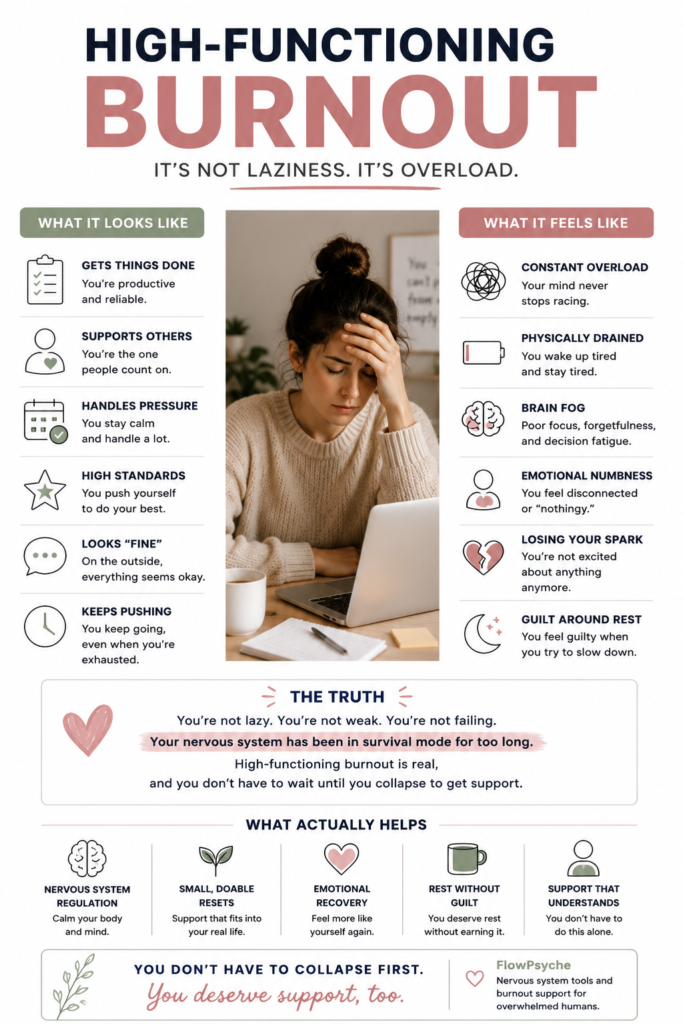
High-functioning burnout is still burnout
Burnout doesn’t always look like falling apart. Sometimes it looks like doing
everything on autopilot, never quite landing in your own body, and needing more
recovery time than you used to for things that used to feel easy.
It can look like losing motivation for the work that used to light you up. Feeling
emotionally flat instead of openly distressed. Smiling at the right moments while a
quiet resentment hums underneath.
This is especially common in people who are used to being needed. Your nervous
system learns to prioritise performance over recovery. Over time, survival mode
starts to feel normal — until you forget there’s another way to live.
The emotional residue of constant caring
Helping work is full of invisible emotional labour. You absorb stress all day: other
people’s emotions, other people’s emergencies, other people’s expectations
dressed up as your own.
Even when you physically leave work, your nervous system often keeps carrying it
home. The body doesn’t clock off just because the day has ended.
When emotional output runs constantly without enough regulation or recovery,
your system can get stuck in a low-level state of alertness. Eventually, your body
starts asking for rest in louder ways — exhaustion, irritability, brain fog, anxiety,
the strange sensation of being detached from your own life.
That’s not weakness. That’s a system that has been overloaded for too long.
Why rest can feel so hard
One of the most disorienting parts of burnout is that the very thing you need —
rest — can feel almost impossible.
You finally sit down, and within minutes you’re restless, guilty, scrolling, or
planning the next thing. You can’t seem to switch off the way you used to.
That’s a nervous system response, not a discipline problem. When your body has
spent years in output mode, slowing down can feel unfamiliar — even unsafe. Your
system has learned that being still might mean missing something, dropping
something, letting someone down.
This is why recovery rarely works through more pressure. It works through small,
gentle, doable things that signal to your body it’s allowed to soften.
You don’t have to collapse before you get to rest
So many people wait until they completely break down before giving themselves
permission to slow down. They wait for the doctor’s note, the breakdown in the car
park, the resignation letter — as if they need a clinical disaster to justify a quieter
life.
Burnout recovery doesn’t have to begin at rock bottom.
Sometimes it starts with a five-minute nervous system reset between meetings.
With letting one email wait. With saying out loud — even just to yourself — I’m
overwhelmed. With reaching for support before you’re already on the floor.
When your system is this overloaded, small things matter more than big plans.
Before we go on — the work you do matters
Most people who do this kind of work don’t hear it nearly often enough.
You hold things other people would crumble under. You stay steady in moments
that should rattle anyone. You absorb stories, fears, and emotions you didn’t ask
for, and you keep showing up the next day anyway.
That work is real. It costs something. And the world doesn’t always notice — partly
because you’re so good at making it look easy, partly because helping work tends
to stay invisible until something goes wrong.
So before anything else: thank you. The hours nobody sees, the energy nobody
clocks, the quiet way you keep things steady for everyone else — it matters far
more than the recognition you’re being given for it.
You deserve care that’s at least as thoughtful as the care you give.
A softer way forward
If you’ve been functioning beautifully on the outside while quietly running on
empty:
You’re not failing. You’re not weak. You’re not behind.
You’ve been carrying a lot, for a long time, in a body that was never designed to be
in caretaker mode 24/7.
Two soft places to start:
The Burnout Reset Kit ($17) — a small, doable collection of tools, scripts, and
nervous system resets to help you take the edge off this week. A gentle place to
start, even if you’re not ready for anything bigger yet.
Get the Burnout Reset Kit → $17
The Burnout Survival Club — an ongoing, low-pressure space for helping
professionals (and anyone whose nervous system has been doing too much, for too
long). Inside you’ll find:
- Short, doable nervous system resets you can use between clients, meetings,
or school pick-ups - Burnout recovery practices designed for tired brains — not another self improvement project
- A community of people who actually get it. No toxic productivity. No fixing.
No shoulds.
Join the Burnout Survival Club →
You shouldn’t have to lose yourself before you decide you
deserve care, too.